Clean Water Science: Building a Simple Water Filter
Discover the science behind clean water by building a working water filter from natural materials. Learn how layers of sand, gravel, and charcoal can turn murky water clearer, and understand why clean water matters.
# Clean Water Science: Building a Simple Water Filter
## Overview
Access to clean water is one of the most important challenges in the world. In this project, students will build a simple but effective water filter using natural materials found locally. Through this hands-on experiment, learners will understand filtration, the water cycle, and why clean water is essential for health and communities.
## What You Will Learn
- How filtration works to remove particles from water
- The role of different materials (sand, gravel, charcoal) in cleaning water
- Why clean water matters for health and communities
- Scientific experimentation and comparison
- Environmental awareness and conservation thinking
## Materials Needed
- A large plastic bottle (cut in half) or a clay pot with a hole at the bottom
- Clean sand (fine grain)
- Small gravel or pebbles
- Charcoal pieces (from wood charcoal, crushed into small bits)
- Cotton cloth or a coffee filter
- Muddy or dirty water (collected from a puddle or made by mixing soil and water)
- Two clean cups or jars for collecting filtered water
- A notebook for recording observations
## Important Note
The filtered water from this project is cleaner but is NOT safe to drink without further treatment like boiling. This is a learning experiment about filtration science.
## Process
### Step 1: Understand the Problem
Start by looking at a cup of dirty water. What can you see in it? Soil particles, tiny leaves, maybe small insects. Discuss: what makes water unsafe? It is not just the things we can see, but also tiny organisms called bacteria that are invisible to our eyes. A filter removes the visible particles, which is the first step in water treatment.
### Step 2: Prepare Your Filter Layers
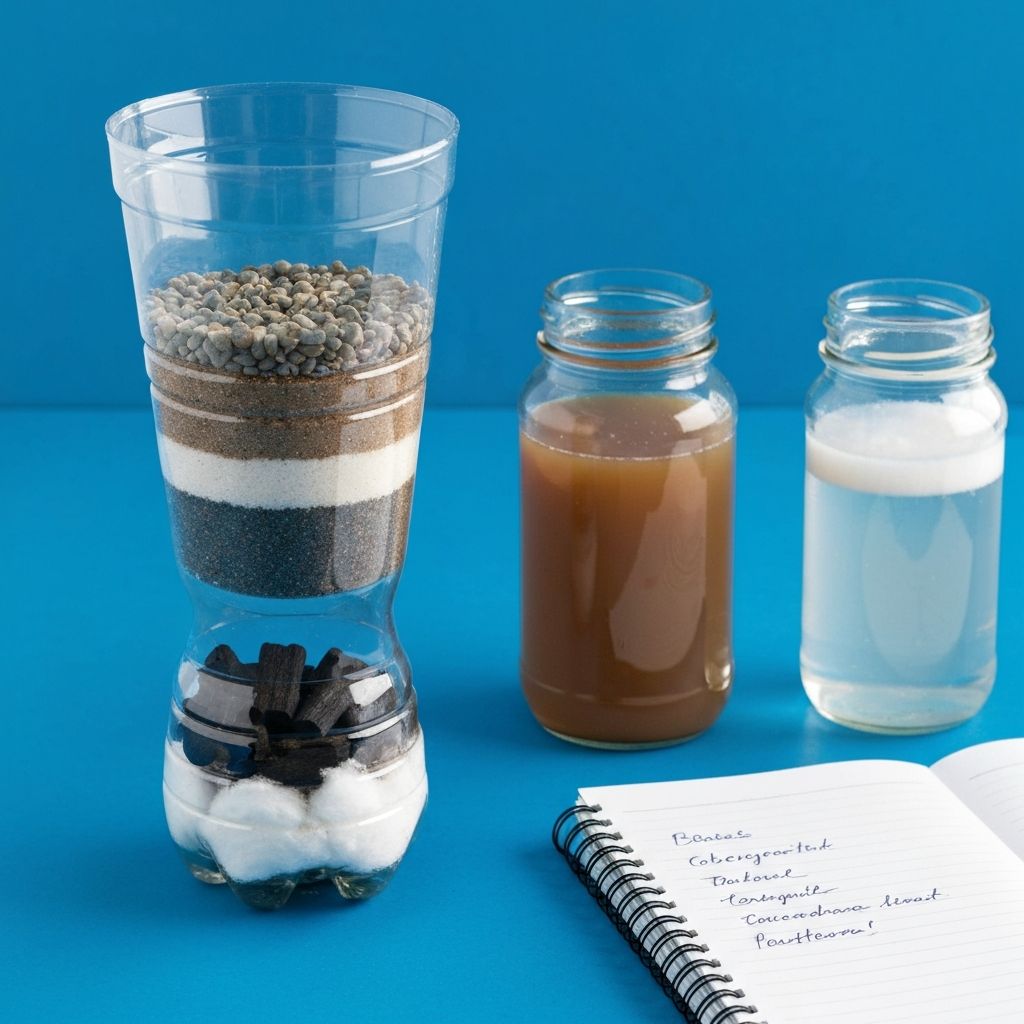
Take your cut plastic bottle and turn the top half upside down so it sits inside the bottom half like a funnel. Place a piece of cotton cloth at the narrow opening. Then add your layers from bottom to top:
- **Layer 1 (bottom)**: Cotton cloth or coffee filter
- **Layer 2**: Fine sand (about 5cm deep)
- **Layer 3**: Charcoal pieces (about 3cm deep)
- **Layer 4**: Coarse sand (about 3cm deep)
- **Layer 5 (top)**: Small gravel or pebbles (about 3cm deep)
### Step 3: Run Your First Filtration
Slowly pour dirty water into the top of your filter. Watch carefully as it passes through each layer. Collect the water that comes out at the bottom. How does it look compared to the water you poured in? Is it perfectly clear or still slightly cloudy? Record your observations and draw what you see.
### Step 4: Compare and Experiment
Run the filtered water through the filter a second time. Is it clearer now? Try building a second filter with the layers in a different order, or skip one layer entirely. Compare the results. Which arrangement produces the clearest water? This is how scientists work: changing one thing at a time to see what happens.
### Step 5: Understand Each Layer
Discuss what each layer does:
- **Gravel**: Catches large particles like leaves and debris
- **Coarse sand**: Traps medium-sized particles
- **Charcoal**: Absorbs chemicals, odors, and some bacteria through a process called adsorption
- **Fine sand**: Catches the smallest visible particles
- **Cotton**: Final barrier for tiny remaining particles
### Step 6: Connect to the Real World
Research how your local community gets its water. Is there a water treatment facility nearby? How do rural communities purify water? Discuss why some communities have easier access to clean water than others, and what can be done about it.
## Age Adaptation
- **Ages 6-8**: Focus on building the filter and observing the difference. Use simple vocabulary.
- **Ages 9-11**: Add the comparison experiment with different layer arrangements. Introduce the idea of bacteria.
- **Ages 12-14**: Research local water treatment methods. Calculate filtration rates. Discuss the global water crisis with data.
## The Science Behind It
Filtration works through both **physical** and **chemical** processes. Physically, particles too large to pass through gaps between sand grains get trapped. Chemically, charcoal uses **adsorption**, where impurities stick to its surface because of its massive internal surface area. A single gram of activated charcoal has the surface area of several tennis courts.
## Cultural Relevance
Water has deep significance in Ethiopian culture and daily life. From the springs of the Blue Nile to community water points, access to clean water shapes how communities live and thrive. Ethiopia has made remarkable progress in expanding clean water access, and understanding water science empowers the next generation to continue this work.
## Discussion Questions
1. Why does running water through the filter twice make it clearer?
2. What is the difference between filtering water and making it safe to drink?
3. Why is charcoal such a good filtering material?
4. How does your community currently access clean water?
5. What would you design if you could create the perfect water filter for your neighborhood?
Project Details
Difficulty
Age Range
Ages 6-14
Estimated Duration
2-3 hours
Category
chemistry
Ready to Start?
This project is designed to help students learn by doing. Gather your materials and follow the steps to begin your learning journey.
Share Your Project Results